Criticisms of Analytic Idealism — Common Objections & Open Questions
Analytic Idealism must be evaluated not only on its explanatory strengths, but in light of its genuine limitations. What follows presents the most substantive objections and identifies areas requiring further development.
Concerns About Falsifiability
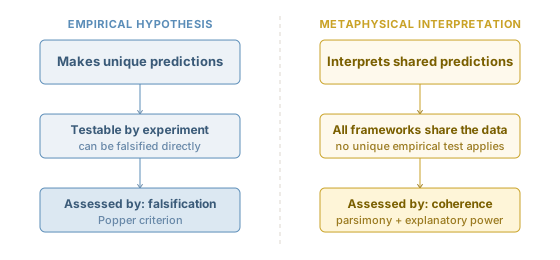
If all observable phenomena are interpreted as appearances of mental processes, it may seem that no possible observation could count against the framework — rendering the position unfalsifiable.
In response, proponents maintain that Analytic Idealism is not an empirical hypothesis but a metaphysical interpretation of empirical data. It is assessed on coherence, explanatory power, and parsimony — not direct experimental falsification. This is consistent with how all foundational metaphysical positions are evaluated. The question is not whether it makes unique empirical predictions, but whether it offers the most coherent interpretation of the predictions that all frameworks share.
The Risk of Re-description
Analytic Idealism may redescribe physical processes in different terms without providing additional explanatory insight. Stating that physical processes are "appearances of mental processes" may not clarify what those processes are or how they operate. The concern is that the framework amounts to a change in vocabulary rather than an increase in understanding.
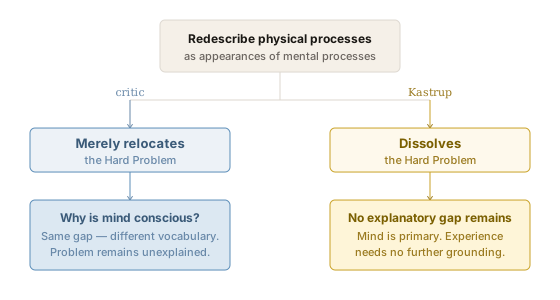
This is a genuine challenge. The response depends on whether the reinterpretation resolves problems that the original description could not — specifically, whether treating consciousness as foundational actually dissolves the Hard Problem or merely relocates it. Kastrup argues it dissolves it; critics are not uniformly persuaded.
The Nature of Dissociation
If reality is fundamentally one consciousness, what accounts for the apparent independence of individual minds? Analytic Idealism invokes dissociation as the mechanism. Critics argue that the nature of this dissociation requires further clarification — particularly how boundaries between centres of experience are established, maintained, and dissolved.
The DID analogy provides an empirical proof of concept but does not fully specify the mechanism. This remains an area of active philosophical development within the framework.
Relation to Panpsychism
Some critics suggest that Analytic Idealism collapses into a form of panpsychism insofar as both attribute mental characteristics to fundamental reality.
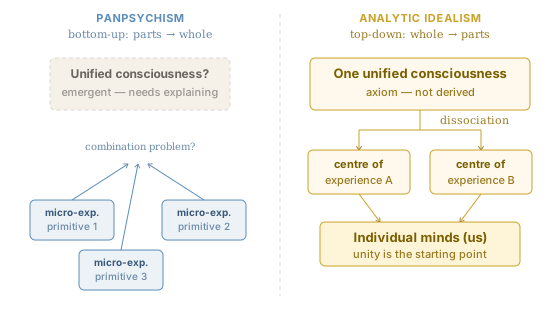
The two positions differ in a critical respect: panpsychism attributes experiential properties to fundamental physical entities and must explain how these combine into unified experience. Analytic Idealism posits one unified consciousness that differentiates through dissociation — the direction of explanation is reversed. Unity is the starting point, not the problem to be solved.
Conceptual Ambiguity
Terms such as "mind", "consciousness", and "appearance" carry multiple meanings across different philosophical contexts. Without careful definition, the framework risks being interpreted in unintended ways — including associations with solipsism, subjective idealism, or mysticism that Kastrup explicitly distances himself from.
This is less a refutation than a demand for precision. The Glossary on this site attempts to address it directly. Readers encountering the framework for the first time are encouraged to consult it before drawing conclusions about what the position does and does not entail.
Explanatory Scope
Does Analytic Idealism provide sufficient detail to explain the full complexity and structure observed in the natural world? Identifying consciousness as fundamental does not, by itself, explain why physical regularities take the specific forms they do — why this universe rather than another.
This is an acknowledged open question. Analytic Idealism does not claim to replace physics — it claims to offer the correct ontological interpretation of what physics describes. The detailed structure of reality remains a question for science. What changes is the metaphysical status of what science is describing.
These criticisms do not refute Analytic Idealism, but they identify the areas where the framework must continue to develop. Any serious engagement with the position requires taking them seriously. The debate is ongoing — and that is exactly as it should be in philosophy.